
Surgery is the only treatment that offers a chance of clearing pancreatic cancer completely. It is also one of the most demanding operations in abdominal surgery, and it is not possible for every patient.
Two things decide whether it can be done: where the tumour sits in the pancreas, and its relationship to the major blood vessels running behind it. This page explains both, and what the operation actually involves.
Not every pancreatic cancer can be operated on
Only a minority of pancreatic cancers are removable at the point of diagnosis. This is not a matter of how advanced your care is or how quickly you act. It is anatomy.
The pancreas sits directly on top of the main blood vessels that supply the intestine and liver. If the tumour has grown around those vessels, removing it is either impossible or would do more harm than good. Scans are used to sort patients into groups.
Resectable. The tumour is clear of the critical vessels. Surgery is possible.
Borderline resectable. The tumour touches or partly involves a vessel. Chemotherapy, sometimes with radiotherapy, is given first to shrink it, and the scan is repeated. A number of these patients become operable.
Locally advanced. The tumour encases the major arteries. Surgery is not appropriate, and treatment is chemotherapy based.
Metastatic. The cancer has spread to the liver, lungs or elsewhere. Surgery on the pancreas does not help, and treatment is aimed at controlling the disease.
If you have been told surgery is not possible, ask which of these four groups you are in. Borderline and locally advanced are not the same thing, and the difference matters. A borderline tumour may become operable after chemotherapy.
The operations
Which one you need depends on where in the pancreas the tumour sits.
Whipple procedure
Also called pancreaticoduodenectomy. This is the operation for tumours in the head of the pancreas, which is where most of them occur.
It removes the head of the pancreas, the duodenum, the gallbladder, the lower bile duct, and in some versions part of the stomach. These structures share a blood supply and sit packed together, which is why they come out as one block rather than the tumour alone.
The digestive tract is then rebuilt. The remaining pancreas, the bile duct and the stomach are each joined to the small intestine. Those three new joins are what make this a long operation and what determines much of the recovery.
Distal pancreatectomy
For tumours in the body or tail of the pancreas. The left portion of the pancreas is removed, usually along with the spleen because the two share blood vessels.
If your spleen is removed, you will need specific vaccinations, ideally before surgery, because the spleen plays a role in fighting certain infections. This is lifelong and should not be skipped.
Total pancreatectomy
The whole pancreas is removed. Used rarely, when the tumour involves the entire gland. It causes permanent diabetes requiring insulin, and lifelong enzyme replacement, so it is only chosen when there is no alternative.
Before surgery
A pancreatic protocol CT scan is essential. This is a specific type of contrast CT timed to show the tumour against the blood vessels. An ordinary abdominal CT is not sufficient to plan this surgery.
Jaundice is often the first symptom, caused by the tumour blocking the bile duct. If your bilirubin is high, a stent may be placed through an endoscopy to drain the bile before surgery. Operating on a deeply jaundiced patient carries more risk.
A biopsy is not always required first. Where the scan appearance is characteristic and the tumour is clearly removable, surgery may proceed without one. Where chemotherapy is planned before surgery, tissue confirmation is needed, and this is usually obtained through an endoscopic ultrasound.
Your general fitness matters as much as the scan. Heart and lung function, nutritional state and blood sugar control are all assessed, because this operation places a heavy demand on the body.
The operation and hospital stay
A Whipple procedure typically takes several hours. Most patients spend the first day or two in intensive care, and the usual hospital stay is around ten days to two weeks, longer if complications occur.
Eating restarts gradually. Drains are left in place initially to monitor the new joins, and are removed once it is clear they are healing.
Complications you should know about
This operation has a genuinely higher complication rate than most abdominal surgery. Being told this beforehand is not discouragement, it is informed consent.
Pancreatic fistula. The join between the remaining pancreas and the intestine leaks pancreatic fluid. This is the most common significant complication of a Whipple. Most cases settle with drainage and time, but it is what lengthens the hospital stay.
Delayed gastric emptying. The stomach is slow to resume working, causing fullness and vomiting. It is common, frustrating, and usually temporary.
Bleeding and infection. Managed as they arise, occasionally requiring a return to theatre or a radiological procedure.
Surgeon and centre volume affects outcomes here more than in almost any other operation. It is a reasonable question to ask how often your surgeon performs this procedure, and what critical care support the hospital has.
Life after the surgery
Enzyme replacement. With part of the pancreas gone, you will likely need enzyme capsules taken with every meal and snack to digest food properly. Without them, expect loose, oily, foul-smelling stools and weight loss. Many patients are underdosed. If those symptoms continue, the dose usually needs increasing rather than accepting.
Diabetes. Blood sugar may rise after part of the pancreas is removed, and after a total pancreatectomy insulin is always required. This is monitored from the start.
Weight and appetite. Weight loss is expected in the first months. Small, frequent meals work better than three large ones. Dietitian input is genuinely useful here rather than optional.
Chemotherapy afterwards. Adjuvant chemotherapy is standard for most patients after successful pancreatic cancer surgery. Surgery alone is not usually the complete treatment, and this is planned once you have recovered enough to tolerate it.
Follow-up continues with clinical review, scans and CA 19-9 blood tests on a set schedule.
Questions worth asking
- Which of the four groups is my tumour in: resectable, borderline, locally advanced or metastatic?
- Has a pancreatic protocol CT been done?
- Should I have chemotherapy before surgery rather than after?
- Which operation is planned, and will my spleen be removed?
- How often is this operation performed here?
- What enzyme and diabetes support will I have afterwards?
Frequently asked questions
Is surgery always possible for pancreatic cancer?
No. Only a minority of tumours are removable at diagnosis, decided by the tumour’s relationship to the major blood vessels. Some borderline cases become operable after chemotherapy.
How long is the Whipple operation and the hospital stay?
The surgery takes several hours, usually with a day or two in intensive care afterwards. The typical hospital stay is around ten days to two weeks.
Can I live without part of my pancreas?
Yes. After a partial removal, the remaining pancreas continues working, though most patients need enzyme capsules with meals and some develop diabetes. After total removal, insulin and enzymes are required permanently.
Will I need chemotherapy after surgery?
Usually yes. Chemotherapy after successful surgery is standard for most patients with pancreatic cancer.
Can this be done laparoscopically?
Some pancreatic operations, particularly distal pancreatectomy, can be done through key-hole access in selected patients. The Whipple procedure is most commonly performed open because of the complexity of the reconstruction.
I have been told nothing can be done. Is a second opinion worthwhile?
It can be, particularly if you are borderline resectable, or if the assessment was made without a pancreatic protocol CT. It is reasonable to have the scans reviewed by a surgeon who performs this operation.
Consultation
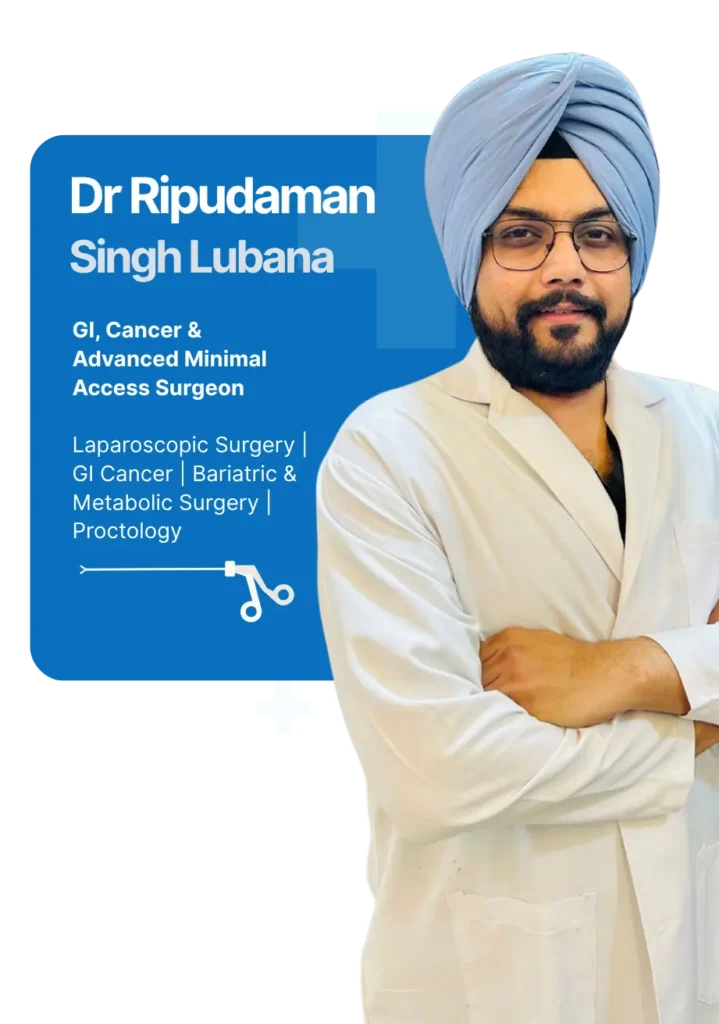
Dr. Ripudaman Singh Lubana holds a Fellowship in Surgical Oncology from Tata Memorial Centre and HBCHRC, Punjab, and a University Diploma in Minimal Access Surgery from IRCAD, France. He has performed over 3500 cancer surgeries across gastrointestinal, colorectal, breast and gynaecologic disease.
He consults at Doctor Square Hospital on VIP Road Zirakpur, Trinity Hospital in Zirakpur, Curasia Hospital in Dhakoli, and Adesh Medical College Hospital in Mohri, Ambala Cantt.
Bring your CT scan images, not only the report, along with any biopsy result and recent blood tests. Call 8054173528 to arrange a consultation.
This page is for patient education. It is not a diagnosis, a prognosis or a treatment plan. Pancreatic cancer treatment differs for every patient depending on the position of the tumour, its relationship to surrounding blood vessels, the stage and individual fitness. Every patient is examined and assessed individually before any treatment is advised.