
A hernia is a gap in the abdominal wall through which tissue from inside pushes out. That is the whole of it. It is a mechanical problem, and it has a mechanical solution.
Two things follow from that, and they are the reason this page exists. A hernia will not close on its own, and no medicine, belt or exercise will repair it.
The types
Inguinal hernia
In the groin. By far the most common, and much more common in men. It shows as a bulge in the groin, sometimes extending into the scrotum, which often appears on standing, coughing or lifting and disappears on lying down.
Ventral hernia
Through the front wall of the abdomen. This covers several types:
Umbilical, at the navel. Common, and often small.
Incisional, through the scar of a previous operation where the healed wound has weakened. These tend to be larger and more complex to repair.
Epigastric, in the midline between the navel and the breastbone.
What it feels like
A bulge that comes and goes, most obvious when standing, straining, coughing or lifting, and often flattening when you lie down. There may be a dragging ache or discomfort by the end of the day, and it usually gets worse with physical work.
Many hernias are not particularly painful. Absence of pain does not mean absence of a problem.
Why waiting has a limit
Most hernias enlarge slowly over time, and a larger hernia is a bigger operation than a small one. That alone is an argument for repairing it while it is straightforward.
The more serious concern is obstruction and strangulation. This happens when a loop of intestine pushes into the hernia and gets stuck. Its blood supply can then be cut off, and the trapped bowel begins to die.
Go to a hospital immediately if the bulge becomes hard, cannot be pushed back in, turns painful or discoloured, or if you develop vomiting and abdominal pain. This is an emergency and it needs treatment within hours, not days.
An emergency hernia operation carries substantially more risk than a planned one, and may involve removing a section of bowel. This is the reason surgeons discourage indefinite postponement.
Can it be managed without surgery?
Not repaired, no. A truss or hernia belt holds the bulge in and may make you more comfortable, but it does nothing to the underlying gap and does not reduce the risk of the bowel getting trapped.
Watchful waiting is occasionally reasonable for a small, symptom-free inguinal hernia in someone unfit for surgery. It is a decision made with a surgeon, not a substitute for seeing one.
The operation
The gap is closed and reinforced with a mesh. The mesh matters. Repairing the defect with stitches alone has a higher chance of the hernia coming back, because the tissue that failed once is being asked to hold again. The mesh spreads the load across healthy tissue around the defect, and your own tissue grows into it over the following weeks.
Laparoscopic repair
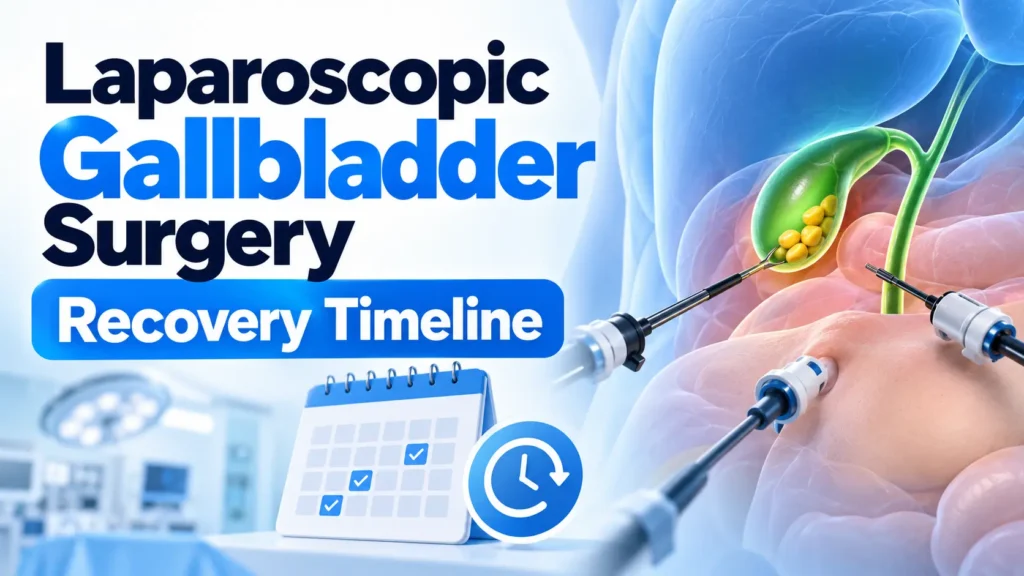
Three small incisions. The mesh is placed from inside the abdominal wall, behind the defect, where the pressure of the abdomen holds it in position rather than pushing against it.
Advantages over open repair: less pain afterwards, an earlier return to work, smaller wounds, and a lower risk of long-term groin pain. It has a particular advantage in hernias on both sides, since both can be repaired through the same three incisions rather than two separate open wounds, and in hernias that have recurred after a previous open repair, because it approaches through undisturbed tissue.
When open repair is the better choice
Laparoscopic repair is not automatically right for everyone. Open surgery may be preferred in very large or long-standing hernias, in emergencies where bowel is trapped, after multiple previous abdominal operations, or where general anaesthesia carries too much risk, since open inguinal repair can be done under spinal or local anaesthesia.
A surgeon who offers you only one technique regardless of your hernia is not choosing, they are defaulting.
Before surgery
Usually an examination is enough to diagnose an inguinal hernia. An ultrasound or CT may be used where the diagnosis is unclear, or to assess the size of a large ventral or incisional hernia before planning the repair.
You will have routine blood tests and a fitness assessment. If you smoke, stopping beforehand genuinely matters here, as smoking impairs wound healing and increases the chance of recurrence. Being significantly overweight and having a chronic cough both raise recurrence rates too, because both keep pushing against the repair.
Recovery
Most patients go home the same day or the next morning.
Walking starts within hours. Expect soreness and some bruising, and in inguinal repairs some swelling in the groin or scrotum, which settles over a couple of weeks.
Desk work is usually realistic within about a week. Driving once you can perform an emergency stop without hesitating. Heavy lifting, gym work and physical labour should wait three to four weeks, and this instruction is not conservative caution. The repair is at its most vulnerable while your tissue is still integrating with the mesh.
Risks worth knowing
Recurrence. No repair has a zero recurrence rate. It is reduced by mesh, by good technique, and by controlling the factors that raise abdominal pressure such as smoking, weight and untreated cough or constipation.
Chronic groin pain. A small number of patients have persistent discomfort after inguinal repair, related to the nerves running through the area. It is less common after laparoscopic repair than open.
Seroma. A fluid collection at the repair site, common, usually resolving on its own. It can be mistaken for the hernia returning.
Injury to surrounding structures. Uncommon, and specific to the location of the hernia.
Mesh infection. Rare, and more likely in emergency surgery than planned repair.
Questions worth asking
- Which type of hernia do I have, and how large is it?
- Is laparoscopic or open repair better in my case, and why?
- What type of mesh will be used and where will it sit?
- Do I have a hernia on both sides?
- When can I return to my specific kind of work?
- What can I do to reduce the chance of it coming back?
Frequently asked questions
Will a hernia heal on its own?
No. It is a physical gap in the abdominal wall and it cannot close by itself at any age. Hernias in infants are a separate situation.
Do hernia belts work?
They may make you more comfortable by holding the bulge in. They do not repair the defect and do not prevent the bowel becoming trapped.
Is mesh necessary?
For almost all adult hernias, yes. Stitch-only repair has a considerably higher rate of the hernia returning.
Is laparoscopic repair better than open?
For most hernias it offers less pain, a faster return to work and less chronic pain. For some situations, including very large hernias and emergencies, open repair is the better choice.
How soon can I lift weights again?
Three to four weeks for most patients, longer for large repairs. Ask specifically about your own repair rather than assuming.
Can it come back after surgery?
It can, though the chance is low with a properly placed mesh. Smoking, significant excess weight, a chronic cough and straining all increase the risk.
I have hernias on both sides. Two operations?
No. Both sides are usually repaired in one laparoscopic operation through the same three incisions.
Consultation
Dr. Ripudaman Singh Lubana holds a University Diploma in Minimal Access Surgery from IRCAD, France, along with FMAS and FIAGES, and performs both laparoscopic and open hernia repair, including complex and recurrent hernias.
He consults at Doctor Square Hospital on VIP Road Zirakpur, Trinity Hospital in Zirakpur, Curasia Hospital in Dhakoli, and Adesh Medical College Hospital in Mohri, Ambala Cantt.
Call 8054173528 to arrange a consultation.
This page is for patient education. It is not a diagnosis or a treatment plan. Every patient is examined and assessed individually, and the choice of repair is made for the individual hernia.