
Gallstones are common. Most people who have them never find out. The ones who do usually find out through pain, and the question that follows is whether the gallbladder needs to come out.
This page answers that, and explains what the operation involves.
When gallstones need surgery, and when they do not
Stones causing symptoms should be treated. Once gallstones have caused pain once, they usually do it again, and each episode carries a risk of something worse than pain.
Stones found by chance, causing nothing, usually do not need surgery. If an ultrasound done for another reason shows stones and you have never had symptoms, observation is reasonable in most cases. There are exceptions, including very large stones, a calcified gallbladder wall, and gallbladder polyps found alongside the stones. These are judged individually.
Being told you have gallstones is not automatically being told you need an operation. Ask which of these two situations you are in.
What the pain feels like
Typical gallstone pain is felt in the upper right side of the abdomen or in the centre just below the breastbone. It often spreads to the back or the right shoulder blade. It tends to come after a heavy or oily meal, builds over a while, lasts from half an hour to a few hours, and settles. Nausea and vomiting are common with it.
It is not usually a constant, low-grade ache. If your discomfort is constant, gallstones may not be the cause even if they are present on the scan.
Why the whole gallbladder is removed, not just the stones
This is the most common question patients ask, and it is a fair one.
A gallbladder that has formed stones will form them again. Removing the stones alone means repeating the surgery within a few years. Removing the organ solves the problem permanently, and the gallbladder is not essential to digestion.
The gallbladder stores and concentrates bile. Once it is gone, the liver simply delivers bile continuously into the intestine instead. For most people this makes no noticeable difference.
What happens if it is left untreated
Continuing with symptomatic gallstones is not a neutral choice. The recognised complications are:
- Inflammation and infection of the gallbladder, which causes constant pain and fever and often requires an emergency admission
- A stone slipping into the bile duct, which blocks the flow of bile and causes jaundice, dark urine and pale stools
- Pancreatitis, where a stone blocks the pancreatic outlet, which can be a serious illness
An emergency operation on an inflamed gallbladder is technically harder and carries more risk than a planned one. This is the main argument for not postponing indefinitely once symptoms have started.
Seek care the same day if you develop severe constant pain with fever, or yellowing of the eyes.
Can medicines dissolve gallstones?
Rarely and unreliably. Dissolution therapy works only for certain small cholesterol stones, takes many months, and the stones commonly return once treatment stops because the gallbladder that produced them is still there. It is not a practical alternative to surgery for most patients.
The operation
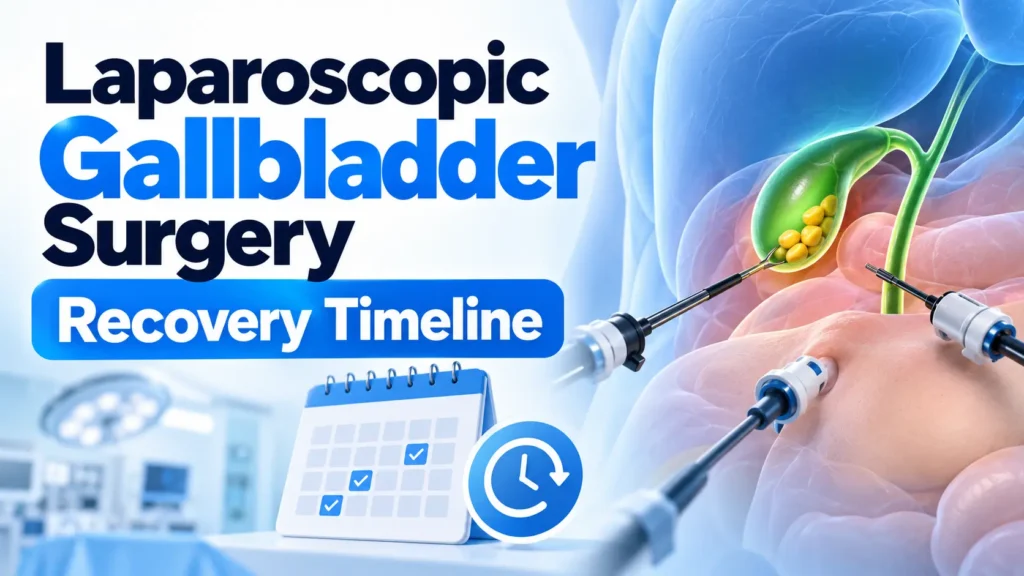
The gallbladder is removed through three or four incisions of roughly half to one centimetre. A camera goes through one, instruments through the others. The abdomen is inflated with carbon dioxide gas to create working space.
It is performed under general anaesthesia and usually takes under an hour, longer if there is significant inflammation or scarring.
If key-hole is not possible
Occasionally the operation is converted to open surgery partway through. This happens when inflammation, scarring from previous surgery, or unclear anatomy makes it unsafe to continue laparoscopically.
Conversion is a safety decision, not a complication or a failure. The alternative, continuing when the anatomy cannot be seen clearly, is what causes serious injury.
Before surgery
You will normally need an ultrasound confirming the stones, liver function blood tests, and a general fitness assessment.
If your liver tests are abnormal or you have had jaundice, further imaging may be needed to check whether a stone has moved into the bile duct. That stone has to be dealt with as well, sometimes through an endoscopy before the surgery.
You will be asked not to eat for several hours beforehand, and given instructions about blood thinners and diabetes medication if you take them.
Risks worth knowing
Most patients recover without any problem, but you should be told the following before consenting:
Bile duct injury. Uncommon, and the most serious potential complication of this surgery. It is why an experienced surgeon will convert to open rather than proceed when the anatomy is unclear.
Bile leak. Occasionally occurs after surgery and may need drainage or a further procedure.
Retained bile duct stone. A stone already in the duct that was not identified beforehand can cause jaundice afterwards, treated by endoscopy.
Bleeding and wound infection. Uncommon with key-hole surgery.
Shoulder pain. Not a complication. An ache in the right shoulder for a day or two is caused by the gas used during surgery irritating the diaphragm, and it settles on its own.
Recovery
Most patients go home the same day or the next morning.
You will be walking within a few hours. Liquids start the same day and normal food usually the next. Desk work is realistic within about a week. Heavy lifting and gym work should wait two to three weeks.
The wounds are small and usually closed with dissolvable stitches and a waterproof dressing. Keep them dry, and avoid baths and swimming until reviewed.
Life without a gallbladder
For the great majority of people, digestion continues normally and no permanent diet restriction is needed.
Some patients notice looser stools or urgency in the first few weeks, particularly after very oily meals. This usually settles as the body adjusts. A small number of people find that very fatty food continues to disagree with them long term.
You do not need to eat a permanently fat-free diet. Reintroduce foods gradually rather than avoiding them indefinitely out of caution.
Questions worth asking
- Are my stones causing my symptoms, or were they found incidentally?
- Are my liver function tests normal?
- Is there any sign a stone has moved into the bile duct?
- How likely is conversion to open surgery in my case?
- When can I return to my kind of work?
Frequently asked questions
Can the stones be removed and the gallbladder kept?
No, not as a durable treatment. The gallbladder that formed stones will form them again, meaning a second operation later.
Is the surgery painful?
Most patients describe soreness rather than pain, managed with routine tablets for a few days. The shoulder ache from the gas is common and short-lived.
How soon can I go back to work?
Around a week for desk work. Two to three weeks before heavy lifting or physical work.
Do I need a special diet afterwards?
Not permanently. Take it gently for the first week or two, then reintroduce normal food. Most people return to eating exactly as before.
What if I just leave the stones alone?
If they are causing symptoms, the risk is a future emergency: infection of the gallbladder, jaundice from a stone in the duct, or pancreatitis. An emergency operation is harder and riskier than a planned one.
Will I have large scars?
No. Three or four marks of about half to one centimetre, which fade over time.
Consultation
Dr. Ripudaman Singh Lubana holds a University Diploma in Minimal Access Surgery from IRCAD, France, along with FMAS and FIAGES, and has performed over 3000 laparoscopic gallbladder surgeries.
He consults at Doctor Square Hospital on VIP Road Zirakpur, Trinity Hospital in Zirakpur, Curasia Hospital in Dhakoli, and Adesh Medical College Hospital in Mohri, Ambala Cantt.
Bring your ultrasound report and any recent blood tests. Call 8054173528 to arrange a consultation.
This page is for patient education. It is not a diagnosis or a treatment plan. Every patient is examined and assessed individually, and surgery is advised only when it is clinically necessary.