Roux-en-Y and mini gastric bypass
A bypass does two things a sleeve does not. It creates a small stomach pouch, and it reroutes food so that it skips the first part of the small intestine.
That rerouting is what gives the bypass its particular strengths: a stronger effect on type 2 diabetes, greater weight loss for most patients, and improvement in acid reflux rather than worsening of it. It is also what creates its main demand on you, which is rigorous lifelong supplementation.
Two versions are commonly performed, and they differ in how many connections are made.
Roux-en-Y gastric bypass
The long-established operation, performed for more than fifty years, with the laparoscopic approach refined since 1993.
The stomach is divided into a small upper pouch, roughly the size of an egg. The remainder of the stomach stays in the body but no longer receives or digests food. The small intestine is divided and connected to the new pouch, and the segment draining the bypassed stomach is joined back into the intestine further downstream, forming the Y shape the operation is named after.
The American Society for Metabolic and Bariatric Surgery describes its effect as working in several ways at once. The pouch holds less. Food skips the first portion of the small bowel, so absorption falls. Most importantly, changing the route food takes has a strong effect on the hormones controlling hunger and fullness, which is why blood sugar in type 2 diabetes frequently improves before any significant weight has been lost.
It also usually improves heartburn, which is the opposite of what a sleeve tends to do.
Mini gastric bypass
Also called the one anastomosis gastric bypass. A longer, narrower stomach pouch is created and joined directly to a loop of small intestine, with a single connection rather than two.
The International Federation for the Surgery of Obesity and Metabolic Disorders recognised it as a standalone bariatric and metabolic procedure in 2018, and it is now the third most commonly performed primary bariatric operation worldwide. Being simpler and faster, with one join instead of two, it appeals for exactly those reasons.
The trade-off is a risk of bile reflux, since bile can reach the stomach pouch through the single connection. Where this becomes troublesome, conversion to a Roux-en-Y is the usual solution. It is also generally avoided in patients who already have significant reflux.
Ask which version is being proposed for you and why. They are not interchangeable.
Who a bypass suits
A bypass rather than a sleeve is generally preferred when you have significant acid reflux, when type 2 diabetes has been present for years or is poorly controlled, when a previous sleeve has not delivered enough weight loss, or when greater weight loss is needed than a sleeve is likely to achieve.
It suits a patient who is prepared to take supplements permanently and attend blood monitoring for the rest of their life. That is not a formality attached to the operation. It is part of the operation.
Who it suits less well
Anyone unlikely to keep up supplementation and follow-up. The nutritional demands after a bypass are considerably higher than after a sleeve, and the consequences of ignoring them are permanent rather than merely inconvenient.
It is also more complex in patients with extensive previous abdominal surgery, and it changes how some medications are absorbed, which needs review beforehand if you take drugs where levels matter.
Before surgery
Endoscopy of the stomach, blood tests including sugar, thyroid, iron, vitamin B12 and vitamin D, an ultrasound of the abdomen, assessment for sleep apnoea, and heart and lung fitness where relevant.
A pre-operative diet for two to three weeks shrinks the liver and makes the surgery safer.
Smoking must stop. After a bypass, smoking and anti-inflammatory painkillers such as ibuprofen both substantially raise the risk of ulcers forming at the join, and ASMBS advises avoiding both. This is not general health advice, it is specific to this operation.
Recovery
Usually two to three days in hospital, slightly longer than a sleeve. Walking within hours.
The staged diet runs over roughly six weeks: clear liquids, full liquids, pureed, soft, then normal textures, with protein prioritised at every stage. Small sips, and no drinking with meals.
Desk work is generally realistic within two weeks, with heavy lifting and strenuous exercise deferred around four to six weeks.
Dumping syndrome
Worth understanding before it happens, because it frightens patients who were not warned.
After a bypass, sugary or high-fat food can pass rapidly into the small intestine and cause cramping, nausea, sweating, palpitations, light-headedness and diarrhoea, typically within half an hour of eating. A later form causes low blood sugar a few hours after a meal.
ASMBS notes it is a common side effect after gastric bypass, that a large majority of patients experience it at some point, and that it usually follows poor food choices. It is unpleasant rather than dangerous, and it is largely preventable by avoiding concentrated sugar. Some patients find it a useful deterrent.
Risks
Leak at a join, the most serious early complication, uncommon, and the reason for close monitoring in the first days.
Ulcer at the join between pouch and intestine, strongly linked to smoking and anti-inflammatory painkillers.
Internal hernia and bowel obstruction, which can occur months or years later. Persistent or severe abdominal pain after a bypass should always be assessed rather than dismissed.
Bile reflux, specific to the mini gastric bypass.
Nutritional deficiencies, including iron, vitamin B12, vitamin D, calcium, folate and occasionally thiamine. These are more likely and more consequential than after a sleeve.
Gallstones with rapid weight loss, and clots in the legs or lungs.
Alcohol is absorbed faster and affects you more strongly after a bypass, and problem drinking is more common after this operation than before it.
Supplements and follow-up
Lifelong, and not optional. A daily multivitamin, iron, vitamin B12, vitamin D and calcium, in doses set for you, with blood monitoring at defined intervals.
Deficiencies develop silently. Nerve damage from prolonged vitamin B12 deficiency can be permanent by the time symptoms appear. This is the single most important thing a bypass patient can get right.
Questions worth asking
- Roux-en-Y or mini bypass, and why that one for me?
- Do I have reflux, and how does that affect the choice?
- What supplements will I take, and how often will bloods be checked?
- How will my diabetes medications be adjusted afterwards?
- Do any of my current medicines need reviewing because absorption changes?
- What symptoms should make me come back urgently, and for how long afterwards?
Frequently asked questions
Is a bypass better than a sleeve?
Not in general, only for particular patients. A bypass usually gives more weight loss, has a stronger effect on type 2 diabetes and improves reflux. A sleeve is simpler with lower nutritional demands. The right answer depends on your reflux, your diabetes and your willingness to commit to supplementation.
Is it reversible?
The Roux-en-Y can in principle be reversed, though this is rarely done. The stomach is divided rather than removed, unlike a sleeve.
Will my diabetes go away?
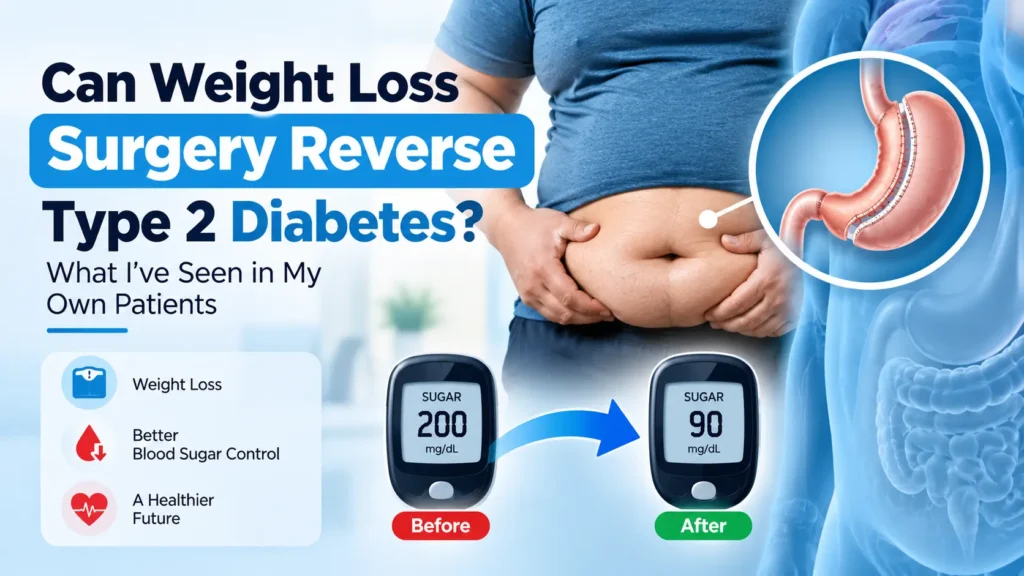
Improvement is common and often begins within days. Complete remission occurs in some patients but cannot be promised, and depends heavily on how long you have had diabetes. Medication changes must be supervised.
What is dumping syndrome and will I get it?
Rapid passage of sugary or fatty food into the intestine causing cramping, sweating, palpitations and diarrhoea. Most bypass patients experience it at some point, usually after eating concentrated sugar, and it is largely avoidable through food choices.
Can I take painkillers afterwards?
Not anti-inflammatory painkillers such as ibuprofen or naproxen, which raise the risk of ulcers at the join. Discuss alternatives if you need regular pain relief.
Will I need vitamins forever?
Yes, without exception, along with regular blood monitoring. This requirement is stricter after a bypass than after a sleeve.
Can I drink alcohol?
Alcohol is absorbed faster and hits harder after a bypass. Caution is advised, and patients with any history of problem drinking should raise it before surgery.
What if I have already had a sleeve that did not work?
Conversion to a bypass is a recognised option, both for inadequate weight loss and for severe reflux after a sleeve. Bring your previous operation notes.
References
- American Society for Metabolic and Bariatric Surgery, Roux-en-Y Gastric Bypass
- Ramos AC, Chevallier JM, Mahawar K, et al. IFSO Consensus Conference Statement on One-Anastomosis Gastric Bypass (OAGB-MGB). Obesity Surgery, 2020
Consultation
Dr. Ripudaman Singh Lubana holds a University Diploma in Minimal Access Surgery from IRCAD, France, and a Certificate Course in Endoluminal Bariatric and Metabolic Surgery from IRCAD India. Bypass, sleeve and endoscopic options are available under one surgeon, so the recommendation reflects what suits you rather than what is on offer.
He consults at Doctor Square Hospital on VIP Road Zirakpur, Trinity Hospital in Zirakpur, Curasia Hospital in Dhakoli, and Adesh Medical College Hospital in Mohri, Ambala Cantt.
Call 8054173528 to arrange an assessment. Being assessed does not commit you to surgery.
This page is for patient education. It is not a diagnosis or a treatment plan. Eligibility, procedure choice and results differ for every patient depending on weight, medical conditions and individual circumstances, and no specific weight loss outcome is promised. Every patient is examined and assessed individually.