Most people arrive at this page for a different reason from the rest of the bariatric section. Not because of weight, but because their blood sugar will not come down despite everything they are taking.
Metabolic surgery is the same set of operations used for weight loss, chosen with blood sugar control as the primary goal rather than weight. It is no longer an experimental idea or a last resort. It sits in the international diabetes guidelines as a recognised treatment option for type 2 diabetes.
Why an operation on the stomach affects blood sugar
The effect is not simply a consequence of weight loss.
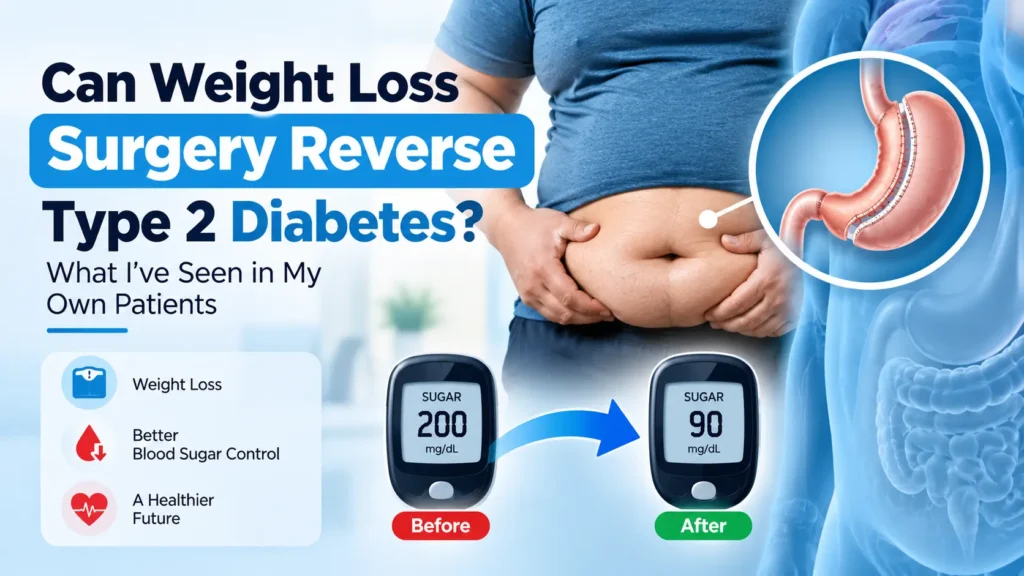
Rerouting food changes the hormonal signals released by the gut when you eat, and those signals influence how insulin is produced and how the body responds to it. This is why blood sugar frequently improves within days of surgery, long before significant weight has been lost, and why patients often leave hospital on lower doses of medication than they came in on.
Weight loss then adds a second, slower effect on top of the first.
What the guidelines say
The 2nd Diabetes Surgery Summit in 2016 produced global guidelines recommending that metabolic surgery be included among the treatments considered for type 2 diabetes in appropriate patients with obesity. Those guidelines were endorsed by dozens of international professional bodies including the American Diabetes Association and the International Diabetes Federation, and were incorporated into the ADA’s Standards of Care from 2017 onwards.
The ADA’s current position is that metabolic surgery should be considered as a weight and glycaemic management approach in people with type 2 diabetes at a BMI of 30 or above, or 27.5 or above in people of Asian ancestry, who are otherwise suitable surgical candidates.
Those Asian-adjusted thresholds matter here. South Asians develop type 2 diabetes and cardiovascular disease at lower body weights and with more abdominal fat than Western populations. A patient in Punjab with a BMI of 29 and uncontrolled diabetes may well be a candidate, even though Western criteria at first glance suggest otherwise.
The same guidelines are clear that this surgery should be performed in centres with teams experienced in managing both diabetes and gastrointestinal surgery, and that long-term nutritional monitoring must be provided afterwards.
Who it suits best
Type 2 diabetes that remains uncontrolled despite optimal medication, including where insulin has been started.
Shorter duration of diabetes. This is the single strongest predictor of a good result. The longer diabetes has been present, the less insulin-producing capacity remains, and the less dramatic the response tends to be. A patient in the first few years does better than one at fifteen years.
Patients still producing their own insulin. Type 1 diabetes is a different disease and does not respond in this way.
Diabetes alongside other weight-related conditions, such as fatty liver, high blood pressure or sleep apnoea, all of which typically improve together.
The practical implication of the duration point is uncomfortable but worth stating: waiting to see whether the next medication works, year after year, reduces what surgery can later achieve.
Which operation
The choice is made differently when diabetes is the target rather than weight.
Gastric bypass is generally favoured for diabetes, particularly where it has been present for years or is poorly controlled, because rerouting the intestine produces the strongest hormonal effect. It also improves reflux.
Sleeve gastrectomy still improves diabetes substantially and is simpler with lower nutritional demands. It may be preferred where a bypass is technically difficult or where supplementation compliance is a concern.
Mini gastric bypass is also used, with a similar metabolic effect to the Roux-en-Y.
The endoscopic route is generally not the right choice where diabetes control is the main objective, because the metabolic effect is weaker.
What to expect
Improvement is common. Remission is possible but never promised.
Blood sugar usually improves within days. Many patients reduce or stop some diabetes medications over the following months, always under supervision rather than on their own judgement.
Complete remission, meaning normal blood sugar without any diabetes medication, does happen, and it is more likely with shorter disease duration and better preoperative control. It is not guaranteed, it is not permanent in everyone, and diabetes can return years later, particularly if weight is regained.
Even where remission does not occur, better control on fewer medications is itself a meaningful result.
Before surgery
Alongside the standard bariatric work-up, diabetes-specific assessment matters here: HbA1c, an assessment of how much insulin your body still produces, screening for diabetic complications affecting the eyes, kidneys and nerves, and a review of every medication you take.
Blood sugar is optimised before surgery, since poor control raises the risk of wound infection and complications.
Afterwards
Medication changes must be supervised. Insulin and sulfonylureas in particular need adjusting quickly after surgery, because continuing pre-surgery doses when your intake has dropped can cause dangerously low blood sugar. Do not adjust these yourself and do not stop attending your physician.
Monitoring continues. Blood sugar checks, HbA1c at intervals, and ongoing screening for eye, kidney and nerve complications. Remission does not remove the need for surveillance, since existing complications still require follow-up.
Nutritional monitoring is lifelong, as with any bariatric procedure, and more rigorous after a bypass.
Your diabetes team and surgical team should both stay involved. This works best as shared care, not a handover.
Risks
The surgical risks are those of the underlying procedure, covered on the sleeve and bypass pages: leak, bleeding, nutritional deficiency, internal hernia after a bypass, reflux after a sleeve.
Two are specific to diabetic patients. Low blood sugar from continuing pre-surgery medication doses, which is why supervised adjustment matters. And slower wound healing and higher infection risk where diabetes is poorly controlled at the time of surgery, which is why control is optimised beforehand.
Questions worth asking
- How long have I had diabetes, and what does that mean for my likely response?
- Am I still producing my own insulin?
- Bypass or sleeve for my particular situation, and why?
- Who adjusts my diabetes medication afterwards, and how quickly?
- What happens to my monitoring if my diabetes goes into remission?
- What are the realistic expectations in my case, not in general?
Frequently asked questions
Can surgery cure my type 2 diabetes?
Improvement is common and remission occurs in a proportion of patients, but no cure can be promised. The likelihood depends heavily on how long you have had diabetes and how much insulin your body still produces.
My BMI is only 30. Do I qualify?
Possibly. The American Diabetes Association recommends considering metabolic surgery from a BMI of 30, or 27.5 in people of Asian ancestry, where diabetes is not adequately controlled by medication. Assessment is individual.
Does this work for type 1 diabetes?
No. Type 1 diabetes is an autoimmune condition in which insulin production is lost, and it does not respond to metabolic surgery in the same way.
How quickly does blood sugar improve?
Often within days, before meaningful weight loss has occurred, because the effect is hormonal rather than purely a consequence of losing weight.
Will I be able to stop insulin?
Many patients reduce or stop some medications, and this must always be done under supervision. Whether insulin can be stopped depends on your individual response.
Can diabetes come back after surgery?
Yes, particularly years later and particularly if weight is regained. Continued follow-up is how this is caught early.
Is this experimental?
No. It has been in the American Diabetes Association’s Standards of Care since 2017, following global guidelines endorsed by dozens of international diabetes and surgical organisations.
References
- American Society for Metabolic and Bariatric Surgery, Type 2 Diabetes and Metabolic Surgery fact sheet
- Rubino F, Nathan DM, Eckel RH, et al. Metabolic surgery in the treatment algorithm for type 2 diabetes: DSS-II joint statement, summarised in Diabetologia, 2017
Consultation
Dr. Ripudaman Singh Lubana holds a University Diploma in Minimal Access Surgery from IRCAD, France, and a Certificate Course in Endoluminal Bariatric and Metabolic Surgery from IRCAD India.
He consults at Doctor Square Hospital on VIP Road Zirakpur, Trinity Hospital in Zirakpur, Curasia Hospital in Dhakoli, and Adesh Medical College Hospital in Mohri, Ambala Cantt.
Bring your HbA1c results, your current medication list and any recent diabetes complication screening. Call 8054173528 to arrange an assessment. Being assessed does not commit you to surgery.
This page is for patient education. It is not a diagnosis or a treatment plan. Eligibility, procedure choice and results differ for every patient depending on diabetes duration, weight, medical conditions and individual circumstances. No specific outcome, including diabetes remission, is promised. Do not change diabetes medication without medical supervision. Every patient is examined and assessed individually.